
I have spent roughly 2/3rds of my career working in-house, working as part of a team to grow the businesses I work for and taking care of all of the work behind the scenes that results in the growth of the business.
Working on the client’s side of the table has instilled in me a real sense of responsibility for the money our clients agree to spend with us now that I’m on the supplier side. The pounds and pence that they agree to spend with us is them sharing some of the resources they’ve worked hard to achieve, which means we ought to be as responsible with them as they are.
When my cofounder and I set up our consultancy, we did so both understanding this about the context of our potential clients. We had both sat as budget holders, justifying why the leadership teams at our respective companies should invest further into our channels. We both wanted to make sure that we were both responsible with their investments and did what we can to maximise the value they saw.
It’s this experience and context which pushed us to create our budget staircasing framework, a simple but responsible framework which poses and answers questions like the following:
- What list of topics represents the best opportunity for the client’s ROI to cover their outlay with us?
- Is there a way to organise our approach, so that we target unlocking events, e.g. x amount in revenue unlocks a push for more competitive terms?
- Can we create parallel work streams: quick wins and Mountains (harder and more competitive verticals to target)
- How does the client’s budget compare to the approach taken - do they need financial upside earlier than we believe is possible?
Staircasing in Action
Our staircasing framework is a toolkit we sometimes deploy as a compliment to our Passage Plans, to plan how we can be responsible with their budget.
The framework is best explained by exploring two different scenarios:
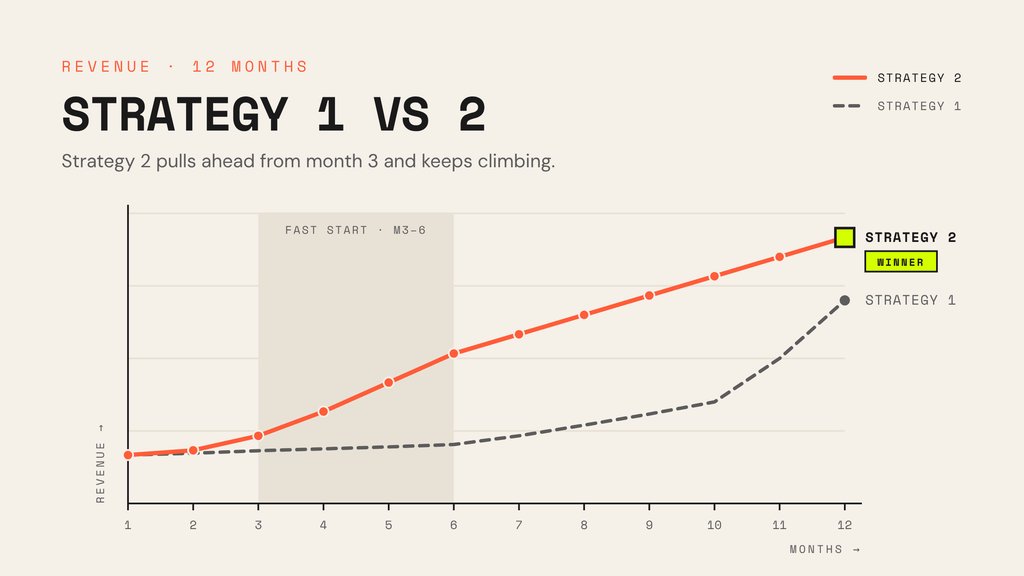
Scenario 1: Kitchen Sink Strategy Annual SEO/GEO budget: £60k
In this strategy the business builds a map of all the topics it wants to target, and gets to work making landing pages. Due to the strategy going after all of the more popular/valuable terms, revenue growth is slow at the start, but hopefully starts showing results as momentum builds - typically resulting in growth in the 3rd or 4th quarter.
Assuming the landing pages are written and published in-house, this approach requires the outlay for the first 6 months to come from the budget, and the company will also need to cover the time of all the hands involved in getting the pages live and kept updated.
Additionally, the CFO of the business is left waiting for 6 months before they can see anything that looks like a return - which means there is 6 months of negligible return on investment with which to either reinvest or reallocate.
Scenario 2: The Starcase Approach Annual SEO/GEO budget: £60k
The staircase framework works by graduating the topics you target, so in the beginning you focus on growing your visibility on easier, less valuable terms, and once you’ve unlocked their revenue, step up to the next cohort of more competitive terms.
By focusing on less competitive terms, revenue starts to show earlier in the project, typically within 3 - 6 months for most websites. The revenue generated can be used to cover both the remaining budget for the year and/or the additional support required to write and publish the pages.
The CFO is now in the situation whereby in month 6, some or all of the allocated budget is now being paid for by the newly generated revenue - which means the budget can be reallocated, reinvested or declared as profit.
Another, less obvious but very powerful, win is that the CFO now feels confident in the investment case for the channel. Delivering revenue growth midway through the financial year fosters confidence in investing more money - as the channel has shown itself to be financially productive.
What is the staircase framework? Now you understand the why behind the framework, I’ll now highlight the how. Whilst relatively simple, the steps below bring together the insights and context necessary to have significantly more complicated conversations - so they are worth the effort.
The staircase framework works as follows:
- We build a market report, which includes the following:
- New and current pages
- Queries for each page
- Monthly Search Volumes
- The top 5 results for each term, as well as their link profiles
- The RPV for each page/topic/service/product.
- We review the SERP for AI and other features, so as to determine how to adjust our CTR for each term
- We then label each landing page with High, Medium and Low labels, based on the metrics collected.
- So for example, if compared to other pages the number of links pointing to all ranking URLs for Topic A is 10% lower than the next nearest page, we would say that page has “Low” competition.
- Using our new labelling, we then cohort pages into groups, such as “Low Hanging”, “Cash Cows”, “Vanity metrics” (lots of traffic, low financial value), “Jackpots”, etc.
- Lastly, we use the newly created groups to build a roadmap that graduates the difficulty of the topics we aim to tackle.
Once complete, we now have a prioritised list of targets - which are sorted by their ability to create growth.
The Secret Level to this Approach
In parallel to this article I am working on another article which discusses how building positive user-signals and topical connectedness using less competitive terms, is a helpful way to improve the likelihood you will rank for more competitive terms.
This idea, which is heavily backed by data from DOJ and Content Warehouse leaks, also works here. By targeting less competitive terms, you are earning clicks and user-signals, which contribute to building a positive perception of your domain.
Positive signals help to power your attempts to rank for more competitive terms, and can improve the performance of new pages - as they can benefit from the wider site reputation.
Bringing it altogether
The aim with budget staircasing is ultimately to play the in-house game better. Trust and confidence in SEO/GEO teams is typically earned, with your results earning you the budget and access you need to win.
Staircasing is therefore about ordering and filtering the things you can do, based on the speed with which they begin contributing to your channel’s growth.