
SEO Pathfinder Reports
One of the most rewarding parts of SEO is the teamwork. SEOs do not typically write the code, draft the copy or design the pages, so we rely on talented teammates to support and facilitate the work we need done.
Where we do add value is we set the course; researching where the opportunities are, establishing the order in which they should be pursued and laying out what tasks need doing to make it so that search engines and AI platforms reward the business with traffic.
Strategy, from a SEO perspective, is therefore an exercise in path-setting.
We use keywords, monthly search volumes (MSVs), link metrics, technical health information and more, to create roadmaps and Epics that have as their aim to figure out and plan fixing broken things, introducing optimisations and growing authority and trust.
When done well, optimised websites should progress in their maturity from disorganised, broken and failing to capitalise on low-hanging opportunities, to led by data, resilient and at the bleeding edge of optimisation.
The challenge with the above is that it is often expensive to do and can take months to create a return for the business. This means SEOs are often less popular than advertising teams, and can have to fight for access to the resources required to be successful.
To help with getting the buy-in and legitimacy required for our clients to win, we produce a Pathfinder report for every client. These reports use market and business data to establish a view of the SEO landscape a business operates in, allowing us and the team to find a path forward that is both achievable and tailored to the business’ interests and appetite.
In this post we explore how we pull together our Pathfinder Reports, what data is included and why, and how we use them with our clients to create a playbook that speaks specifically to the objectives and requirements of their business.
Building the Pathfinder Report
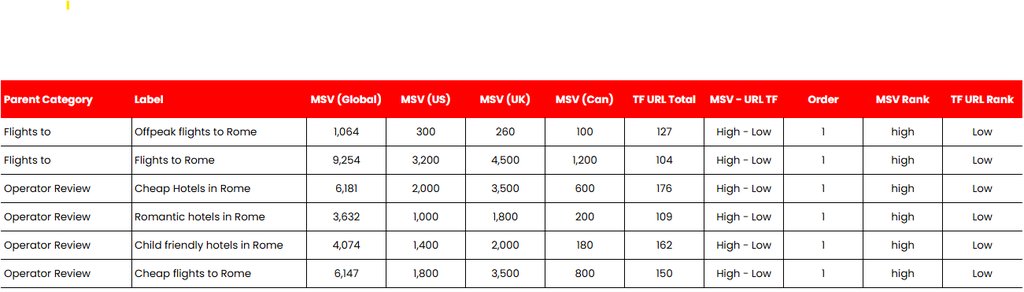
The first step in creating a strategy has to be researching, mapping and quantifying keywords. Regardless of whether keywords and their associated Monthly Search Volumes (MSV’s) are a faultless datapoint, it’s practical to differentiate between topics using MSV’s to T-Shirt size the value of terms and topics.
Our preferred approach is to start by mapping keywords to topics and sub-topics, and then overlaying MSV’s for each keyword.
To get a view of competitiveness, we then pull the top 5 results for each keyword and overlay Majetic’s Trust Flow data for the URL and sub-domain. We prefer Trust Flow because it is less of a measure of count of links, and more of distance from a trust set of quality domains - making it harder to game.
We include absolute rank (of all the features on the page, what is the rank of a given listing) and whether an AI Overview or AI Mode feature is present (and its position in the SERPs), to understand and account for any noise or opportunities that exist alongside the web results.
Lastly, if and where available, we also like to include Average Order Value and conversion rate to allow for commercial insights alongside SERPs data.
In the report section, the file organises topics based on whether they are high, medium or low value in terms of either their MSV’s or expected revenue, and whether they are high, medium or low competitiveness based on offsite competitiveness. To make the numbers relative to the target domain, the competitiveness scores are available as both objective or relative scores - and the opportunity numbers only indicate the delta in clicks/revenue (allowing for if a page already is in the top 5).
Adding Opportunity Labels
With our classifications in place, we can now begin cohorting opportunities based on their scores - we call them opportunity labels. Below are some popular examples
Low Hanging Opportunities | Traffic/Value: High or Medium | Competitiveness: Low
These opportunities are approachable and their value to the business significant enough to justify spending time after strategic work focusing on them. They typically only require a small amount of additional attention, and as such can be done one a month over the course of the year.
Pro tip: Low hanging opportunities are also valuable as they can be used to justify overlay spending, if the team for example generates additional revenue outside of the main strategy, that money hasn’t been anticipated - so it’s a great way to justify CAPEX projects or additional offsite spend to make sure you hit your targets.
Mountains | Traffic/Value: High or Medium | Competitiveness: High or Medium
Mountains are projects which require focused effort and potentially new workflows or teams, but should have a significant impact on the business. It’s typical for Mountains to consist of large gaggles of pages, such as Supplier Reviews or Service Pages; which through their number and value usually create significant upside to the business.
Due to the competitiveness of Mountains, they best fit into the box of being 3 - 6 month strategies and typically require significant budgeted resources to fulfil and maintain. Put another way, they are not typically edge of desk projects, and will become core pillars in the business’ trading.
Bread and Butter | Traffic/Value: Low | Competitiveness: Low
Early stage businesses are typically tempted by competing with larger websites that have pages for the most competitive terms in an industry, motivated by the belief that having the pages is in some way the price of admission for showing and earning riches.
Whilst topical authority is important and therefore having more competitive pages is arguably a good idea; it realistically has very little chance of creating P&L impact to the business (which is worsened when you consider the costs associated with writing and maintaining the pages).
A helpful, slightly more boring, approach is to ask where can I begin generating revenue based on my site’s current metrics, creating the growth needed to fund more competitive verticals.
This is where the Bread and Butter cohort makes lots of sense, targeting approachable terms that are not valuable enough for the larger companies but can comfortably pay the bills, is a great way to build both sponsorship internally and the budget required to win.
AI Targets | Traffic/Value: Medium or Low | Competitiveness: Low
Being included in AI Overviews or AI mode has significantly different requirements than doing so in organic search - which means it can be a great target for budget constrained businesses looking for a growth hack.
Finding topics which are being covered in AI features, have low competition and medium traffic, is a great way to maximise the likelihood you’ll be able to leapfrog to the top of the SERPs.
Creating a world view
The aim of our Pathfinder reports is to establish the data that informs a business’ world view - which they can then use to find their strategic focus. It marries together SEO data with trading data, so that modelling can take place which takes into consideration trading value, competitiveness and expenditure.
Using the researched numbers, topics and labels, we are able to ask questions based on the company’s objectives, budgets and ambition.
Examples of which include:
- If given as a number, where is the opportunity available to hit the growth the business is looking for?
- How do we manage strategic risk? Can we target a position 2 strategy so as to manage the board’s expectations for a more ambitious list of SERPs.
- Should the strategy focus on web results, AI or both?
- Where can we deliver value quickest, and with the highest level of confidence?
- What is the expected link spend associated with a topic, and how long will the payback period be on the expense?
- What can be done without a large spend on content or links?
- How important is defending the traffic we have already? What is the size of the gap between your domain and competitors?
Depending on the answers to the above, we begin to understand what opportunities exist and how they should be approached.
For example, as we know how many links an average competitor has, we can glean an understanding of how much OPEX spend on links is required to better the market and earn a foothold at a domain and URL level.
Often, this report highlights that there are several ways to hit a company objective; therefore to make a decision - it may be helpful to bring together additional stakeholders. Recently, a client changed completely how we approached their strategy by their GM explaining the latent value in having more market share in a specific vertical, as it allowed their commercial teams to sell more valuable inventory and would improve the positioning of the business in the market.
Pathfinder Reports
As mentioned in the introduction, the Pathfinder report is something we build for all clients that engage us for their Search and AI strategy, and is internally considered the price of admission for establishing where and how a given client can win.
The insights and conversations that come from this report lead into our “Playbooks”, which are an outline of the strategy and deliverables we would recommend based on the data we have.
It’s worth adding at this point that the playbooks also use data from discovery audits for technical, offpage and on-page performance of the website - as all of these considerations inform what is the right path forward.
If you have any questions or would like to discuss us creating Pathfinder report and Playbook for your business, please feel free to get in contact using our form below. We also have anonymised example reports we would be happy to share.